
Save the journalists

The New Yorker posted an interesting article on the future of journalism in the digital age this week. It discusses the failures of CNN and the New York Post following the Boston Marathon bombings and the fake AP tweet that resulted in a Dow flash crash on April 23.

It’s worth noting that, while the hacker’s mode of transmission was social media and high-frequency trading, the immediate target was that relic from a previous era, the Associated Press. The Syrian Electronic Army had previously hacked into the accounts of CBS, NPR, and the BBC. These digital soldiers don’t like Western news coverage of the Syrian civil war, and they take the mainstream media seriously enough to try to damage it. Perhaps they take the mainstream media more seriously than people here and in Britain do.

Excellent point. No one seems to take the mainstream media seriously anymore. And according to this Harvard survey very few young Americans trust the media to do the right thing:
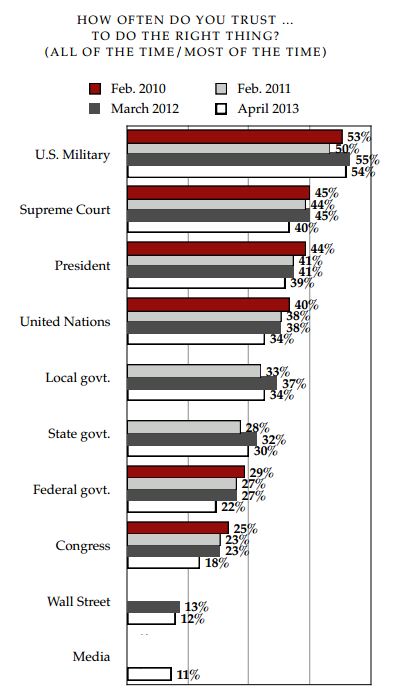
harvard-survey

Given the recent evidence and general trends in mainstream journalism, that’s hardly surprising. But as I argue in my dissertation, neglecting the crucial political role of the news media and instead blindly jumping on the social media bandwagon isn’t doing us any favors. As George Packer points out in The New Yorker piece, it undermines journalists and the important work they do:

And journalists, the ones who do it for a living, will continue to have their faith in the profession shaken, as they panic and let their own standards slip in order not to be embarrassed by Reddit at 2:43 in the morning. But unlike high-frequency traders, Internet entrepreneurs, and online vigilantes, journalists have a stake in those standards, which are the only reason for having professionals do the job. When people are fighting for survival they can forget the long-term interests that are its only guarantee. Perhaps the triumphs and debacles of Boston, and the Syrian Electronic Army prank on the stock market, will serve to remind journalists of how badly they’re still needed, as long as they exercise their best qualities, which include, among other things, self-restraint.
“Art, in my view, is a very elegant problem-solving model.”

I certainly didn’t plan for my first post on this blog to be about the sad state of contemporary American cinema, but Steven Soderbergh makes some excellent points in his State of Cinema Talk.

On art and why it matters:

Art is also about problem solving, and it’s obvious from the news, we have a little bit of a problem with problem solving. In my experience, the main obstacle to problem solving is an entrenched ideology. The great thing about making a movie or a piece of art is that that never comes into play. All the ideas are on the table. All the ideas and everything is open for discussion, and it turns out everybody succeeds by submitting to what the thing needs to be. Art, in my view, is a very elegant problem-solving model.

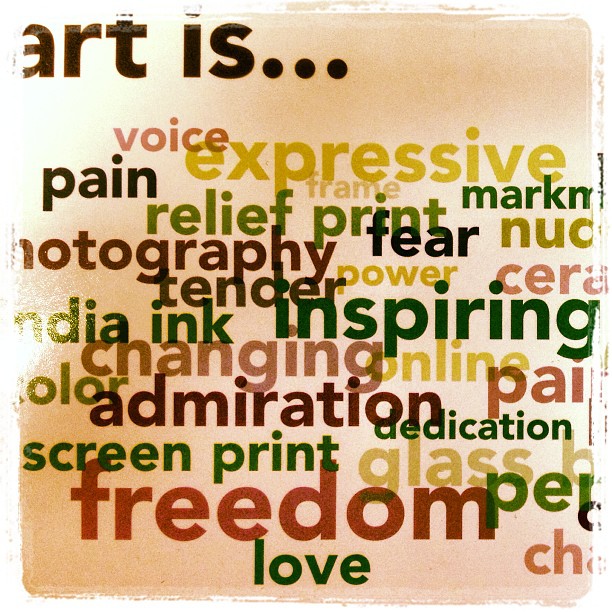
Added visual bonus (just because this flyer for the university’s students’ exhibit was lying on my desk):

artis

On the current problems of the movie industry:

“But the problem is that cinema as I define it, and as something that inspired me, is under assault by the studios and, from what I can tell, with the full support of the audience. The reasons for this, in my opinion, are more economic than philosophical, but when you add an ample amount of fear and a lack of vision, and a lack of leadership, you’ve got a trajectory that I think is pretty difficult to reverse.”

It doesn’t take much to draw parallels to the equally sad state of the mainstream news media in this country. The race to the bottom of the likes of CNN is driven by economics rather than philosophy, and the distinct lack of vision about the future of the news media in the age of Twitter and YouTube amplifies this terrible trend.

On how to keep going:

So whenever I despair I think, OK, somebody out there somewhere, while we’re sitting right here, somebody out there somewhere is making something cool that we’re going to love, and that keeps me going.

When it comes down to it, this is a great way to start this blog after all. With a reminder that there are reasons not to despair, even if we get bombarded with news about the malfunctioning of all kinds of systems on a daily basis: the political, the social, the various professional ones and pretty much all the other ones in between. It’s the reason I’m writing again in the first place. Also: hope.